Single-Arm Seated Cable Row
How to Do a Lat-Biased Single-Arm Cable Row & feel it in your lats.
If rows hit your traps, mid back or arms more than your lats, the setup and elbow path are usually why. Training one side at a time helps you feel your lats, clean up imbalances and keep momentum out of it. Here's how I set it up and cue it.
Full demo video
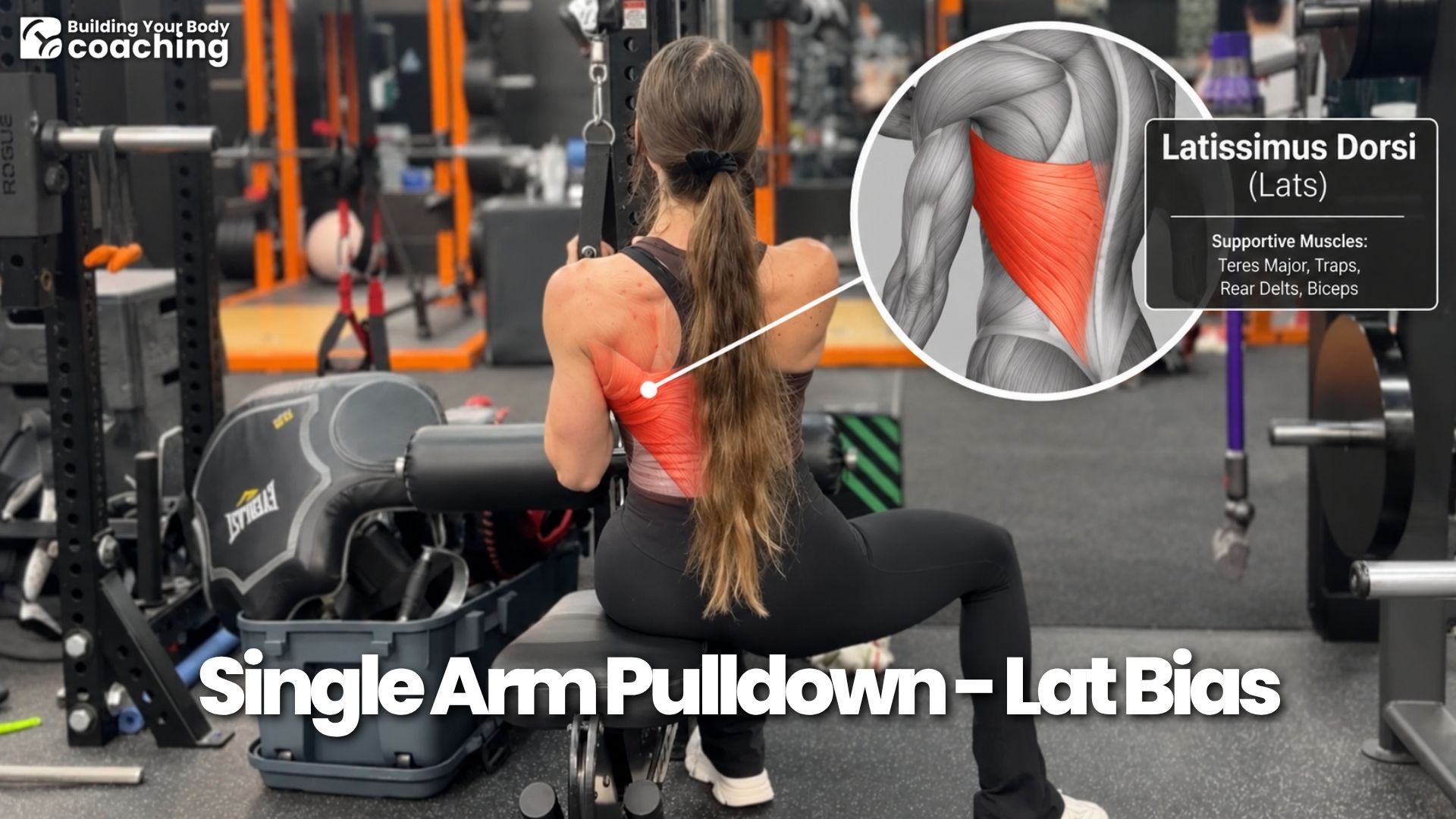
Single-Arm Seated Cable Row with a Lat Bias

Watch me walk through the offset setup, the elbow path and the mistakes that pull your traps into it.
What a lat bias means
This row mainly works your lats (latissimus dorsi), with help from your teres major, rear delts, mid traps and biceps.
A lat bias puts the majority of the tension on your lats. It doesn't turn off your upper back or arms. They still help, but your lats are more likely to be the muscle that tires first.
Your lats pull your upper arm down and back toward your hip. That's why your elbow path matters: driving your elbow down toward your hip lines up with the direction of your lat fibers.
Because it's a cable, the resistance stays fairly even through the whole rep. In this variation, tension is highest at the end of the rep, when your elbow is close to your side and your lat is fully contracted.
How to do it
*Optional* Sit slightly off-center. Scoot to the side so the cable runs straight in line with your working arm and hip. If your left arm is working, scoot to the right so the cable runs through your left wrist, elbow and shoulder, down toward your left hip. If that feels awkward, you can sit centered, but offset is the best setup for a lat bias.
Set a stable base. Plant your working-side foot firmly on the platform. Your other foot can be grounded too, to make a stable base.
Brace with your free hand. Rest your non-working hand lightly on your working-side thigh to help stop your torso from rotating.
Stack your ribs over your pelvis. Brace your abs and keep your spine neutral. Don't lift your chest high into an arch. A slight lean toward the cable is fine, especially if your shoulder mobility is limited, but avoid twisting.
Start with light tension. Before you row, let your shoulder blade gently reach forward without collapsing your posture. Your arm should be slightly in front of your torso, not flared out wide.
Drive your elbow down first. Start each rep by driving your elbow down toward the floor, then drag it back along the line of your thigh toward your hip.
Elbow to your back pocket. Think about scraping your elbow down and back into your back pocket, keeping it close to your side.
Stop when your arm is in line with your torso. Finish when your upper arm is in line with your body. Don't let your elbow travel behind you.
Pause and feel your lat. Pause briefly at the end. Your shoulder should feel like it's being pulled down toward your hip, not shrugged up.
Return along the same path. Let your elbow travel forward along the same line, letting your shoulder blade gently reach forward while your ribs stay stacked and your core stays braced. Control it both ways, no jerking. The goal is tension on your lat, not just moving the stack.
Feeling cable rows in your traps or arms?
You're pulling your elbow too far back. When your elbow travels behind your torso, your traps and rhomboids take over.
Stop the rep when your upper arm is in line with your torso.
Your elbow is flaring out wide. When your elbow moves away from your body, the tension shifts to your upper back and rear delts.
Keep your elbow tight to your side and think "elbow to hip."
You're twisting your torso. If your chest twists hard to move the weight, your obliques and momentum are doing the work instead of your lat.
Lighten the load and brace with your free hand on your thigh so your ribs stay stacked over your pelvis.
Lat-biased single-arm cable row form checklist
- Sit offset so the cable lines up with your working arm and hip
- Working-side foot planted, free hand braced on your thigh
- Ribs stacked over your pelvis, spine neutral
- Arm slightly in front of you, not flared
- Elbow down first, then back toward your hip
- Elbow close to your side
- Stop with your upper arm in line with your torso
- Shoulder down, not shrugged
- Return along the same path, with control
Questions
Why do I feel cable rows in my traps instead of my lats?
Usually because your elbow travels too far back behind your torso or flares out wide. Both shift the work to your traps, rhomboids and upper back. Keep your elbow close, drive it toward your hip and stop when your upper arm is in line with your torso.
How do I make a cable row more lat-focused?
Sit offset so the cable lines up with your working arm and hip, drive your elbow down first and then back toward your back pocket, keep it close to your side and stop with your upper arm in line with your torso.
Why sit off-center on a single-arm cable row?
So the cable runs straight through your wrist, elbow and shoulder toward your hip, which matches how your lat pulls. Sitting centered is fine if offset feels awkward, but offset is the best setup for a lat bias.
Is it normal to feel my biceps on lat-biased rows?
Yes. Your biceps and upper back still help. A lat bias just puts most of the tension on your lats so they're more likely to tire first.
How far back should I pull on a lat-biased row?
Until your upper arm is in line with your torso. Pulling your elbow behind you brings in your traps and rhomboids.
Every exercise in BYB comes with a demo like this.
Follow your workout plan
Coach-built programs with a demo for every exercise.