Bulgarian Split Squat
How to Do a Glute-Biased Bulgarian Split Squat & feel it in your glutes.
Quads burning instead of your glutes? How you set up and move through a split squat decides whether it's more quad or glute focused. Here's how I set up and cue the Bulgarian split squat to put more of the work on your glutes.
Full demo video
Glute-Biased Bulgarian Split Squat
Watch me walk through the setup, the cues I use and the mistakes that shift the work to your quads.
What makes it glute-biased
This version of the Bulgarian split squat, with your back foot elevated, puts more emphasis on your glute max, the largest of your three glute muscles. It's hardest at the bottom, when your glutes are most stretched.
The glute bias comes from more hip bend and less knee bend: pushing your hips back and letting your torso lean forward, instead of letting your front knee travel forward over your toes. That lets your glute stretch under load.
It's still a squat pattern, so it's normal to feel your quads working too. In any squat, lunge or leg press, you can shift more of the load toward your quads or your glutes, but you can't fully isolate one muscle.
How to do it
Pick the right bench height. Use a bench or box tall enough that your back knee doesn't hit the floor as you sit back. Mid-calf height usually works well, but it depends on your limb length.
Set your feet. Stand about two to three feet in front of the bench and place the top of your back foot on it. Your front leg is the working leg. Your back leg is only there for support and balance.
Check your front foot distance. Your front foot should be far enough forward that at the bottom your front shin stays close to vertical and your back knee is just above the floor. Not so far out that you overstretch and cut your range of motion short.
Hold the dumbbell on the back-leg side. Hold the dumbbell in the same-side hand as your back leg. The glute of your front leg does the work.
Hold on lightly for balance. With your free hand, lightly hold a rack or something sturdy. It makes balance easier so you can focus on form and loading the glute. Use it for balance only, don't pull yourself up with it.
Keep your weight in the front leg. Nearly all your body weight stays in your front working leg. Very little should shift to your back leg as you sit back.
Hips back first. Inhale and push your hips back toward the bench behind you as you lower. Let your torso lean forward naturally, then allow a light knee bend. Both knees bend, but the focus is on your hips traveling back, not your front knee driving forward over your toes.
Stop at about 90 degrees. At the bottom, your front knee is bent to about 90 degrees, your front shin is close to vertical, your hips have traveled back, your torso is leaning slightly forward and your back knee is just above the floor. This is where it feels heaviest, and the weight should be loaded into your front glute.
Drive up through your whole front foot. Engage your glute and push through your entire front foot to drive your hips forward and your chest up at the same time. Don't bounce out of the bottom.
Control the way down. Keep every rep slow and controlled, especially on the way down. Tension on the glute is lowest at the top, so the work happens as you drive up from the bottom. You don't need to squeeze hard at the top.
Feeling Bulgarian split squats in your quads?
You're staying too upright. Staying tall cuts your hip hinge and shifts load to your quads.
Let your chest lean forward naturally as your hips go back, so the load stays on your front glute.
When your front knee travels forward over your toes, the movement becomes more quad-biased.
Think "hips back first" and keep your front shin close to vertical. If you can't, move your front foot a little farther out.
You're going too deep. Sitting deeper than about a 90-degree bend at the front knee shifts more load to your quads
Stop when your front knee is at about 90 degrees and your back knee is just above the floor.
If you're pushing off your back foot, your front glute isn't getting the load.
Keep nearly all your weight in your front leg. The back foot is for balance only.
You're bouncing out of the bottom, which pulls tension off your glute
Slow down, control the bottom and drive up without a bounce.
Common form mistakes
Your front foot, ankle and knee fall out of line.
If your front knee drifts outward and your big toe lifts, your glute can't work as well, and the extra pressure on the inside of your knee can cause knee pain. Fix: Point your toes and knee forward and keep your big toe pressed firmly into the ground.
Your back knee sways outward.
This lets your hips twist out of position. Fix: Keep your hips square and think about pulling your back knee in.
You're pulling yourself up with your support hand.
Your arm takes over work your glute should be doing. Fix: Hold on lightly for balance only and let your lower body do all the work.
Glute-biased Bulgarian split squat form checklist
- Bench about mid-calf height
- Front foot far enough out to keep your shin close to vertical
- Dumbbell in the same hand as your back leg
- Free hand on a rack, for balance only
- Weight in your front leg
- Hips back first, torso leans forward
- Stop at about 90 degrees at the front knee
- Toes and knee forward, big toe down
- Drive up through your whole front foot
- Slow on the way down, no bouncing
Questions
Why do I feel Bulgarian split squats in my quads?
Usually because you're staying too upright, letting your front knee drive forward or going deeper than about 90 degrees. Push your hips back first, let your torso lean forward and keep your front shin close to vertical. Feeling some quads is still normal.
How do I make Bulgarian split squats more glute-focused?
Push your hips back and let your torso lean forward as you lower, keep your front shin close to vertical, stop at about a 90-degree bend at the front knee and keep your weight in your front leg.
How far should my front foot be from the bench?
Start about two to three feet in front of the bench. Adjust until your front shin stays close to vertical at the bottom and your back knee is just above the floor, without overstretching.
Which hand should hold the dumbbell?
The same-side hand as your back leg. Use your other hand to hold onto a rack lightly for balance.
How high should the bench be for Bulgarian split squats?
High enough that your back knee doesn't hit the floor. Mid-calf height usually works well, but it depends on your limb length.
Should I squeeze my glutes at the top?
You don't need to. Tension on the glute is lowest at the top. The work happens as you drive up from the bottom.
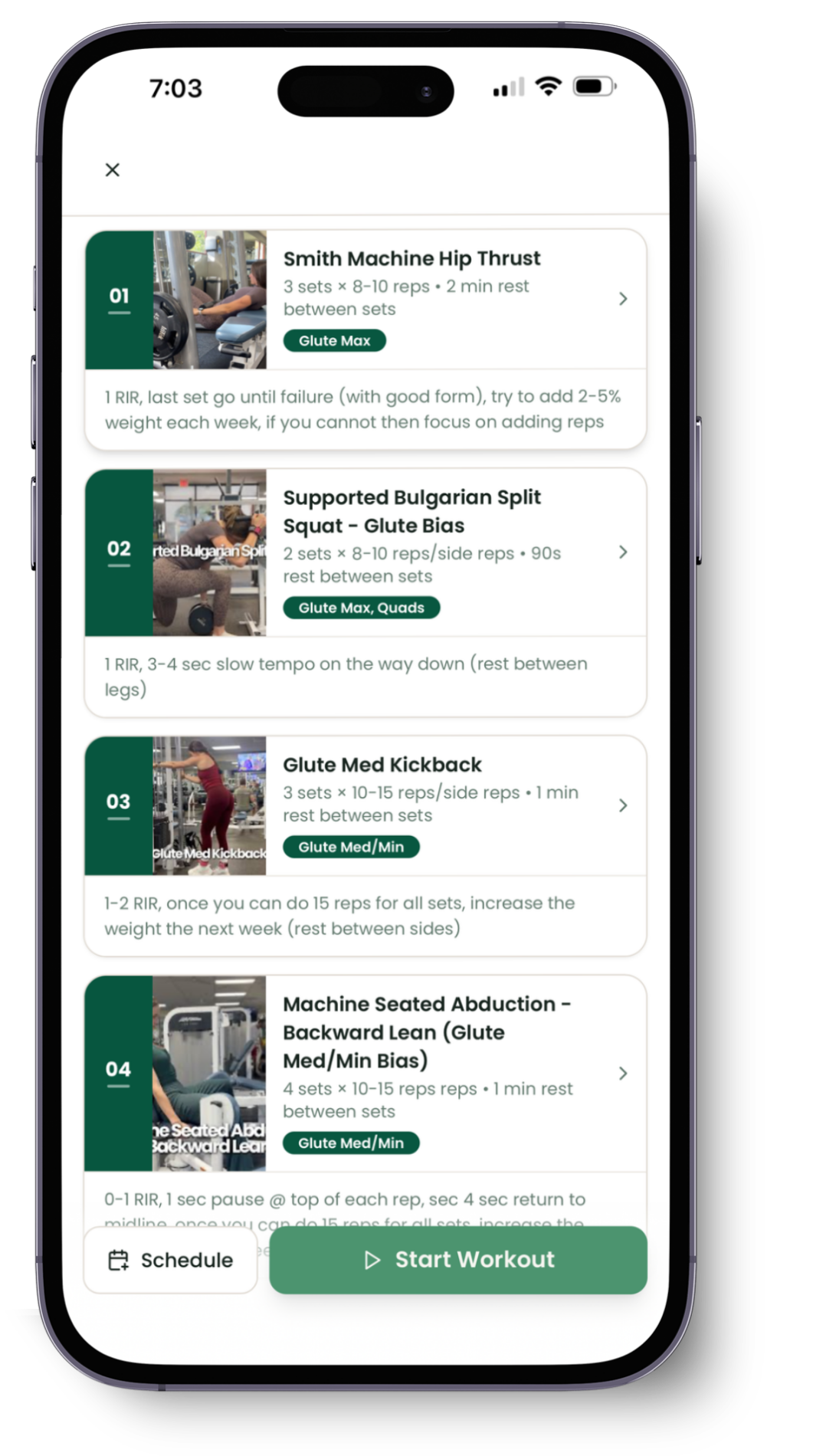
Every exercise in BYB comes with a demo like this.
Follow your workout plan
Coach-built programs with a demo for every exercise.