
How to Build Muscle Without Getting Bulky: A Guide for Women
Building muscle doesn't have to mean gaining unwanted body fat. Learn how to structure your strength training, nutrition, recovery, and daily activity to build muscle and achieve a leaner, more defined physique.
How to Build Muscle Without Getting Bulky: A Guide for Women
If your goal is to build muscle, look more toned, and achieve a leaner, more defined physique, you may have wondered at some point: How do I build muscle without getting bulky?
Maybe you've started lifting weights and noticed your legs or arms getting bigger, but you're not necessarily seeing the muscle definition you were hoping for.
Or maybe you're hesitant to start lifting heavier weights because you're worried about building more muscle than you actually want.
The thing is, there are a few different reasons you might start looking or feeling bigger when you're strength training.
Building muscle and looking bulky are not the same thing.
In fact, the muscle you're worried about building might be exactly what you need to achieve the shape and definition you're working toward.
The key is understanding the relationship between muscle growth, body fat, and nutrition, and how to adjust your approach based on your body composition goals.
Can Lifting Weights Actually Make Women Bulky?
Yes, women can absolutely build enough muscle to achieve a very muscular physique.
But building the amount of muscle you see on competitive female bodybuilders takes years of intentional training, nutrition, recovery, and dedication.
Their entire lifestyle is often structured around maximizing muscle growth.
That's very different from strength training three or four days a week to build muscle, improve your body composition, and feel stronger.
Muscle growth is a SLOW process, especially once you've been strength training consistently for several years.
You're not going to suddenly develop an extreme amount of muscle because you increased your dumbbells from 15 to 20 pounds.
However, there's another reason women sometimes feel like they're getting bulky from strength training, and it doesn't necessarily have anything to do with building too much muscle.
Why You Might Feel Bigger Instead of More Defined
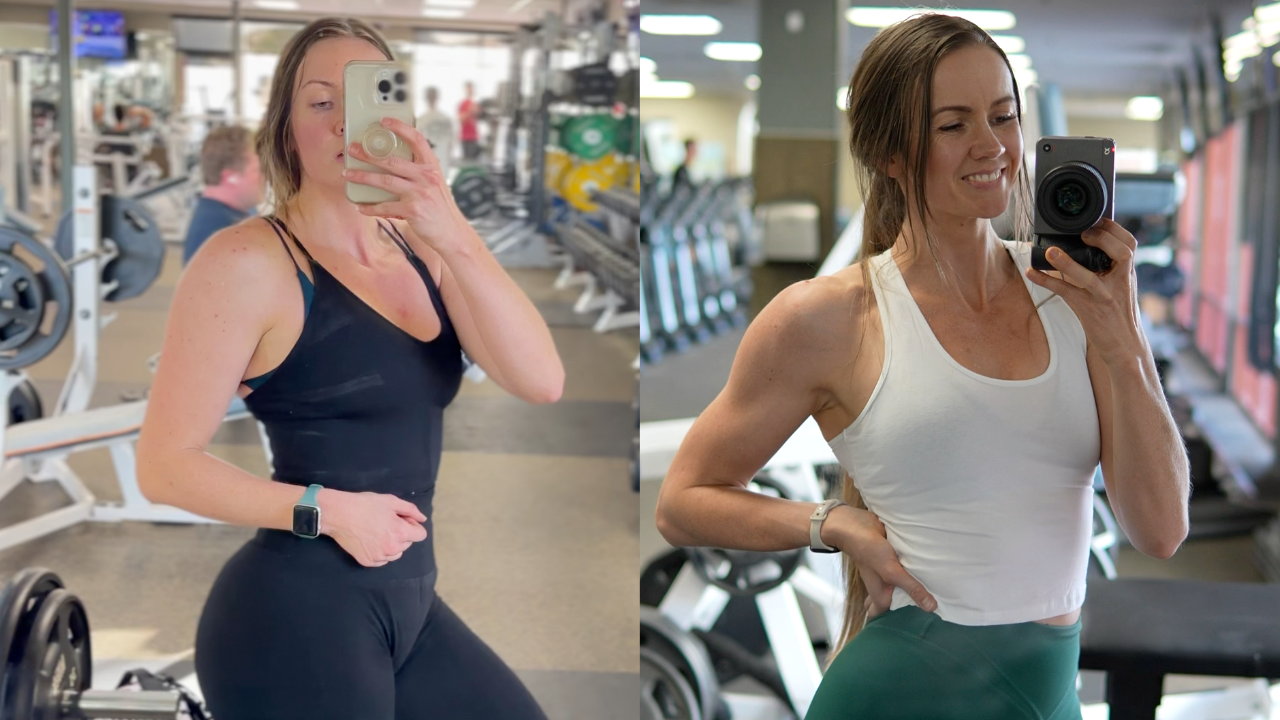
When women tell me they're afraid of looking bulky, I think a lot of the time what they're actually describing is having more body fat than they'd like relative to the amount of muscle they have.
And I can relate because I've experienced this myself.
Around the time of my Hashimoto's diagnosis, I had gained approximately 25 pounds.
But here's the interesting part.
My strength training routine hadn't really changed.
I was still lifting weights four days a week, following the same workouts, and training with relatively the same intensity.
What had changed was everything happening outside of the gym.
I was feeling exhausted, so my daily steps had dropped. I wasn't doing nearly as much cardio, and honestly, my nutrition habits weren't as consistent as they had been previously.
Over time, I gained body fat.
And even though I was still strength training, I started to look and feel bigger without necessarily building a significant amount of additional muscle.
For me, the issue wasn't that I had built too much muscle.
My body composition had changed because my energy balance had changed.
And that's an important distinction.
There's also a limit to how much muscle your body can actually build in a given week or month.
Even with a perfectly structured training program, proper nutrition and consistent recovery, building a few pounds of actual muscle takes months (maybe even years), not weeks. And the more experienced you become with strength training, the slower that process generally gets.
So if you've gained five pounds over a few weeks while strength training, that doesn't mean you've suddenly built five pounds of muscle.
Changes in body fat, water retention, and glycogen storage can all contribute to increases in body weight and changes in how your body looks.
That's why gaining size while strength training doesn't automatically mean you're building too much muscle.
Understanding Muscle Growth vs. Body Fat Gain
Before we get into how to build muscle without feeling bulky, it's important to understand how muscle growth and body fat gain work.
Muscle Growth Is a Gradual Process
Building muscle, also known as hypertrophy, requires consistent strength training, adequate nutrition, and recovery.
Over time, your muscles adapt to your workouts by gradually growing bigger and stronger.
But there's a limit to how quickly your body can actually build new muscle.
Even with a prefecttly structured training program, proper nutrition, and consistent recovery, building muscle takes time.
So how much muscle can women realistically build?
A 2025 study published in The Journal of Physiology followed 27 women who were new to strength training through a 12-week workout program.
After three months, researchers found that, on average, the women had:
Gained approximately 1.8 pounds of lean body mass, which includes muscle and other tissues.
Increased their thigh muscle size by approximately 6%, based on measurements of the muscles themselves.
Improved their leg press strength by 27%.
So while these women became significantly stronger over just three months, the actual amount of muscle-related weight they gained was relatively small.
And it's worth mentioning that the 1.8 pounds represented lean body mass, not necessarily 1.8 pounds of pure muscle. Lean body mass measurements also include water and other tissues.
Another study published in Medicine & Science in Sports & Exercise examined muscle growth in previously untrained women over six months.
Researchers found that the women's arm muscles grew by approximately 11% during the first three months, with additional growth occurring over the following three months.
And remember, these were women who were relatively new to strength training.
Women who have already been lifting consistently for several years generally build additional muscle more slowly than beginners.
How Much Muscle Can Women Realistically Gain Per Month?
The amount of muscle you can build also depends on how long you've been strength training.
Women who are relatively new to lifting typically have the greatest potential for muscle growth, while those who have been training consistently for several years generally gain muscle at a much slower rate.
Realistic monthly muscle gains for women tend to look something like this:
Beginner (first year of consistent strength training): Approximately 0.5–0.75% of body weight in muscle per month. Beginners typically experience the fastest muscle growth because their bodies are adapting to a new training stimulus.
Intermediate (1–3 years of consistent training): Approximately 0.25–0.5% of body weight in muscle per month. As you build more muscle and become more experienced, additional muscle growth generally happens more slowly.
Advanced (3+ years of consistent training): Approximately 0.25% of body weight in muscle per month or less. At this stage, muscle growth is considerably slower, and building even a few additional pounds of muscle can take a year or longer.
These are general estimates based on coaching models, not exact rates established by clinical studies. And, actual muscle growth varies considerably between individuals.
To put that into perspective, a woman who's relatively new to strength training might build several pounds of muscle during her first six months of consistent training.
But a woman who's already been lifting for five years might spend that same six months working toward gaining just another pound of muscle.
Muscle growth takes time, and changes in your body weight can also come from increased body fat, water retention, and the carbohydrates your muscles store for energy.
So if you're strength training and noticing that you're getting bigger, it's worth looking at your overall body composition before assuming you've built too much muscle.
Body fat can accumulate more quickly
Body fat gain occurs when you consistently consume more calories than your body burns over time, also known as a calorie surplus.
But here's where building muscle and gaining body fat are very different.
Your body can only build muscle at a relatively limited rate, regardless of how much you eat or how hard you train.
Body fat, on the other hand, doesn't have that same limitation on how quickly it can accumulate.
When you consistently eat more calories than your body needs, the excess energy will be stored as body fat. And the larger and more sustained that calorie surplus is, the more body fat you have the potential to gain.
Eating twice as many calories won't make you build muscle twice as fast, but it will lead to significantly more body fat gain.
That's why it's entirely possible to gain five, ten, or even more pounds over a relatively short period without gaining anywhere near that amount of muscle.
And when you have more body fat covering the muscles you've built, you may not see as much of the definition you're working toward.
So if you're strength training and noticing that you're getting bigger, don't automatically assume you've built too much muscle.
Your training might be doing exactly what it's supposed to do, but your nutrition and overall energy balance may not be aligned with your body composition goal.
5 Ways to Build Muscle Without Getting Bulky
If your goal is to build muscle while maintaining a leaner, more defined appearance, here's what I recommend focusing on.
1. Follow a Structured Strength Training Program
First, don't be afraid to lift weights.
If your goal is to build muscle and improve your body composition, strength training should be a major focal point of your routine.
But that doesn't mean you need to spend six days a week in the gym or train every muscle group with endless exercises. For most women, three to four well-structured strength training sessions per week is a great starting point for building muscle.
For example, our BYB Fitness Online Group Training program includes three to four workouts per week, and a popular training split I program is:
Day 1: Lower Body – Focus on your glutes, quads, and hamstrings
Day 2: Upper Body – Train your back, shoulders, chest, and arms
Day 3: Lower Body – A second glute focused lower-body session
Day 4: Upper Body (Optional) – An additional session for women who have the time and recovery capacity to train four days per week.
This structure allows you to train your major muscle groups consistently throughout the week while still having time for recovery.
And you should NOT completely change your workouts every week to continue making progress. Repeating many of the same exercises for several weeks is one of the best ways to track whether you're actually getting stronger.
Let's say your program includes dumbbell Romanian deadlifts for three sets of 8–12 reps.
If you complete 10 reps with 25-pound dumbbells this week, your goal for the following weeks might be to work toward 12 reps with that same weight.
Once you're consistently completing all three sets of 12 reps with good technique and only a few reps left in the tank, you can increase the weight and work your way back up through the rep range.
That's progressive overload, and it's how you continue challenging your muscles enough to stimulate growth.
You can also adjust your training based on where you personally want to build more muscle.
For example, if your goal is to develop your glutes, you might prioritize exercises like hip thrusts, Romanian deadlifts, and split squats across your two lower-body sessions.
If you're happy with the amount of muscle you've built in your shoulders or arms, you don't necessarily need to keep increasing the amount of training you dedicate to those areas. You can shift your focus toward maintaining that muscle instead.
The goal isn't necessarily to maximize muscle growth everywhere.
It's to build and maintain muscle in a way that supports the physique you're working toward.
2. Match Your Calorie Intake to Your Body Composition Goal
This is arguably one of the most important pieces of the puzzle.
Your nutrition should support what you're actually trying to achieve.
If you want to build muscle but also have body fat you'd like to lose, eating in a calorie surplus would not be the best starting point.
Instead, you may benefit from focusing on fat loss while maintaining your muscle, or pursuing body recomposition, which involves building muscle and losing fat over time.
Depending on your starting point and training experience, this may be possible around maintenance calories or with a moderate calorie deficit.
On the other hand, if you're already relatively lean and want to prioritize building more muscle, eating at maintenance or in a small calorie surplus may be more appropriate.
You don't automatically need to bulk to build muscle.
The right calorie intake depends on your individual starting point, activity level, and body composition goals.
There's no one-size-fits-all calorie recommendation for building a leaner, more defined physique. Two women with the exact same goal may need completely different nutrition strategies depending on their current body composition.
If you're not sure which approach makes the most sense for your current body composition, our free Body Recomp Blueprint helps you figure out whether your starting point should be fat loss, muscle building, or body recomposition, so you can align your training and nutrition with your actual goal.
3. Prioritize Recovery to Support Muscle Growth
When you're trying to build muscle and lose body fat, it's tempting to think that doing more will get you better results.
More workouts, more cardio, fewer rest days.
But... you only grow from what you can recover from.
Strength training provides the stimulus for muscle growth, but your body needs adequate recovery to adapt to that training and build muscle over time.
And when you're eating in a calorie deficit, recovery becomes especially important because your body has less energy available to support both training and recovery.
Here are a few ways to make sure you're recovering adequately:
Aim for 7–9 hours of sleep per night. Consistently getting enough sleep supports muscle recovery, training performance, and appetite regulation.
Give your muscles time to recover between challenging workouts. For example, if you're training your lower body on Monday, you might train your upper body on Tuesday before returning to lower body on Thursday.
Avoid doing more cardio than needed. Cardio is great for your cardiovascular health and can support fat loss, but excessive amounts, especially alongside challenging strength training and a calorie deficit, can make recovery more difficult.
Pay attention to your training performance. If your strength is consistently declining, you're feeling unusually fatigued, or you're struggling to recover between workouts, it may be time to adjust your training volume, nutrition, or recovery.
Remember, the goal with body recomposition isn't to burn as many calories as possible. It's to create an environment where you can maintain or build muscle while gradually reducing body fat.
And sometimes that means doing less, not more.
4. Support Your Body Composition Goals With Daily Movement
Your strength training workouts are an important part of building muscle, but your activity outside of the gym also plays a significant role in your overall body composition.
Think about it. You might spend an hour in the gym four days a week, but what you're doing during the other hours of your day matters, too.
Your daily steps, cardio, and general movement all contribute to your total daily energy expenditure (TDEE), or the total number of calories your body burns throughout the day.
One important component of this is NEAT (Non-Exercise Activity Thermogenesis), which refers to the calories you burn through everyday movement outside of structured exercise.
Things like walking your dog, cleaning the house, grocery shopping, taking the stairs, or simply spending more time on your feet all contribute to NEAT.
And these small activities can add up throughout the day!
This was actually a big part of my own experience when I gained 25 pounds during my Hashimotos diagnosis.
I was still strength training four days a week, following the same workouts, but because I was feeling so fatigued, my daily steps had dropped significantly, and I wasn't keeping up with my usual cardio.
My strength training hadn't changed, but my overall daily activity and energy expenditure had decreased.
And when you're working toward losing body fat while maintaining or building muscle, changes in your daily activity can make a difference.
The good news is that you don't need to spend hours on a treadmill or add another intense workout to increase your daily movement.
Here are a few simple ways to incorporate more activity into your routine:
Set a realistic daily step goal. If you're currently averaging 4,000 steps per day, start by working toward 6,000 rather than immediately jumping to 10,000. The goal is to gradually increase your activity to a level you can consistently maintain.
Incorporate 2–3 cardio sessions per week. Try 20–30 minutes of moderate-intensity cardio, such as incline walking, cycling, swimming, or using the elliptical. These sessions can complement your strength training and improve your cardiovascular fitness.
Take short walks throughout the day. A 10-minute walk after lunch, walking your dog in the evening, or getting up to move between work tasks can help increase your daily activity without requiring another trip to the gym.
Keep your activity relatively consistent. If you're averaging 9,000 steps per day one month and suddenly drop to 4,000 the next, your calorie needs may change even if your strength training and nutrition stay exactly the same.
And remember, more activity isn't always better.
You don't need to maximize your daily calorie burn or spend hours doing cardio to build a leaner, more defined physique.
The goal is to establish a level of daily movement that supports your body composition goals while still allowing you to recover from your strength training.
Your strength training helps you build and maintain muscle, while your daily movement and cardio contribute to your overall energy expenditure and cardiovascular health.
Finding a balance between the two can help you make consistent progress without feeling like you need to spend your entire day exercising.
5. Track Your Body Composition, Not Just Your Weight
One of the biggest mistakes you can make when trying to build muscle without gaining unwanted body fat is relying exclusively on the scale.
Your weight alone can't tell you whether you're gaining muscle, gaining body fat, or experiencing normal fluctuations from water retention and glycogen storage.
Instead, look at the bigger picture! Use progress photos, body measurements, workout performance, and longer-term weight trends to evaluate your progress.
For example, if your body weight is relatively stable, your strength is improving, and your waist measurements are gradually decreasing, you may be making positive changes in your body composition even without seeing a significant change on the scale.
And if you're consistently gaining weight faster than expected while your goal is to minimize body fat gain, it may be time to reevaluate your calorie intake and overall activity.
The goal isn't to obsess over every measurement.
It's to have enough information to make informed adjustments instead of constantly second-guessing your progress.
The Bottom Line: You Can Build Muscle Without Unwanted Body Fat Gain
Looking more defined isn't necessarily about building less muscle. It's about finding the right balance between muscle development and body fat.
Muscle contributes to the shape of your physique, supports your strength, and plays an important role in your long-term health.
But building muscle and managing body fat require an approach that considers both your training and nutrition.
You need a training and nutrition strategy that matches your body composition goal. And that's going to look a little different for everyone.
Not Sure Whether You Should Build Muscle, Lose Fat, or Focus on Body Recomposition?
If you're consistently strength training but aren't seeing the muscle definition or physique changes you're working toward, it might be time to take a closer look at your overall plan.
Our free Body Recomp Blueprint helps you identify whether your next step should be fat loss, muscle building, or body recomposition based on your starting point and goals.
The BYB Fitness App brings your strength training, nutrition, and progress tracking together in one place, making it easier to stay consistent and know exactly what to focus on.
When you get started, you'll have access to:
Structured strength training programs: Follow progressive workouts designed to help you build muscle, improve strength, and track your performance over time, with options for different schedules and fitness levels.
Personalized nutrition goals: Get calorie and macro recommendations based on your individual goals, whether you're focusing on fat loss, muscle building, or body recomposition.
Meal planning tools: Plan meals around your nutrition goals with recipes, meal-building tools, and grocery lists that make eating consistently a little easier.
Workout and progress tracking: Log your weights, sets, and reps, track personal records, and monitor changes in your body weight, measurements, and overall progress.
Coach Support: Ask a coach a question, any time!
And as you get stronger and your body composition changes, you can continue tracking your results and making adjustments to your training and nutrition along the way.
Because building muscle and improving your body composition isn't about finding a new workout or diet every few weeks. It's about having a plan you can consistently follow, track, and adjust as you progress.
Ready for a plan that fits your life?
Choose self-guided training, join group coaching, or work with Coach Kales 1:1.
Start TodayRelated articles
Body Recomposition: How to Build Muscle and Lose Fat
Want more muscle, less body fat, and progress you can actually see? Here's the 4-step body recomp approach Coach Kales would start with from scratch.

How Much Protein Do You Really Need Per Day?
How much protein do you really need? Learn how to find your daily number, why a calorie deficit calls for more, and how to hit your goal without living on chicken breast.